Projects & Publications

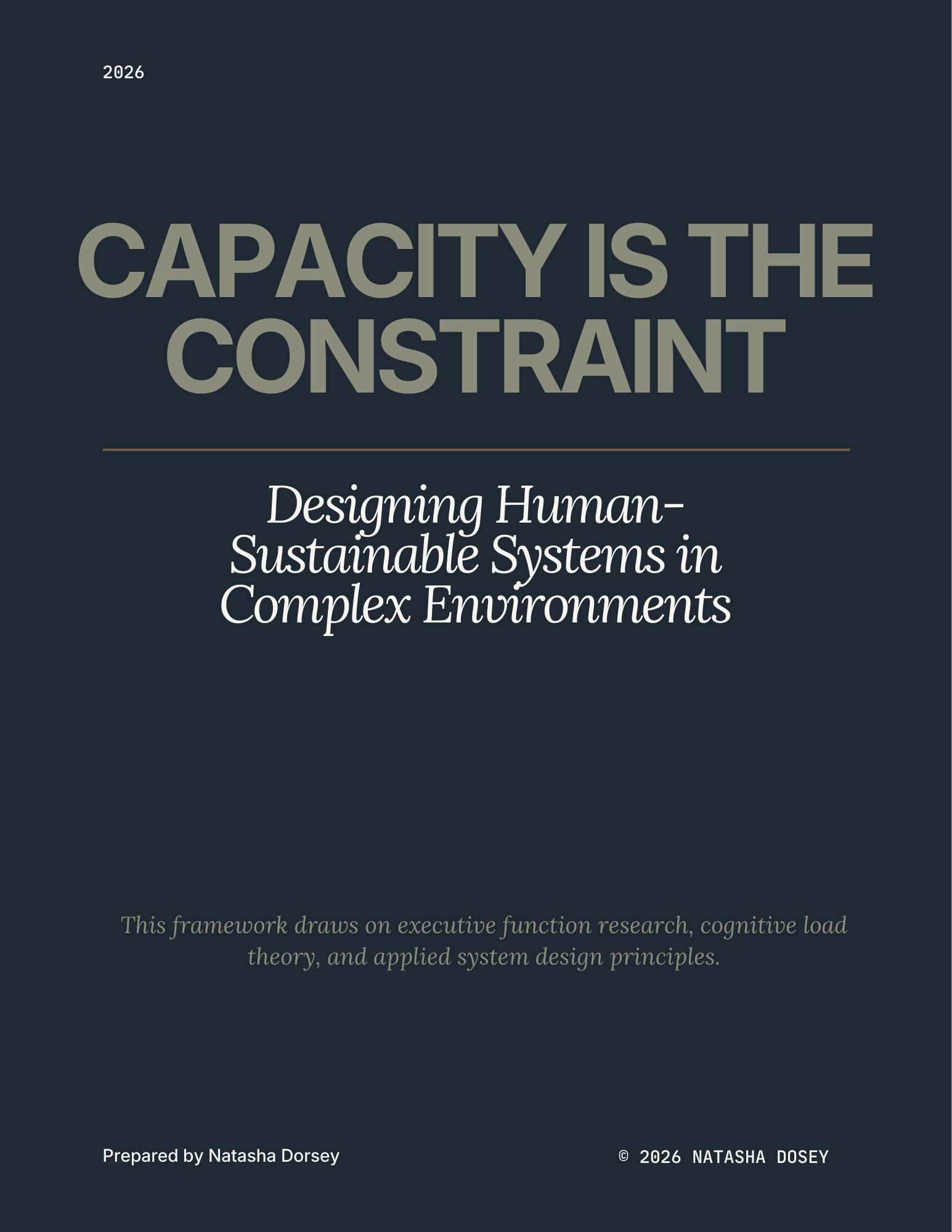
Cover page of a book titled "Capacity is the Constraint: Designing Human-Sustainable Systems in Complex Environments" by Natasha Dorsey, published in 2026.

Key Takeaways

  • Capacity, not effort or buy-in, is the primary constraint in complex human systems

  • Systems often appear stable because they rely on invisible over-functioning

  • Sustainable performance requires structural design, not additional individual adaptation

Capacity Is the Constraint

Designing Human-Sustainable Systems in Complex Environments

These systems brief outlines a capacity-aware framework for understanding why burnout, attrition, and implementation failure persist even in well-intended organizations, and how system design can address these challenges directly.

Rather than focusing on individual resilience or motivation, the brief reframes performance as an outcome of structural alignment between demand and human capacity.

Who This Is For

This brief is written for:

  • Senior leaders and executives

  • Boards and governing bodies

  • Policymakers and system designers

  • Organizations operating in complex, high-pressure environments

It is intended as a decision-support resource, not a proposal or program.

See the Brief PDF

People-First Approach

·

Reliability & Accountability

·

Sustainability

·

People-First Approach · Reliability & Accountability · Sustainability ·

The 4 Step Leadership Process

  • Geometric drawing of an outline square with sections divided by vertical, horizontal, and diagonal lines.

    Observe the System

    This step focuses on identifying points of overload, friction, and misalignment between expectations and human capacity.

  • Geometric drawing of an outline square with sections divided by vertical, horizontal, and half circle lines.

    Interpret Breakdown as Information

    When an approach does not work, it is treated as feedback, not failure. Breakdowns reveal where cognitive load is too high, structures are unclear, or demands exceed capacity.

    Rather than escalating control or effort, leaders use this information to refine design.

  • Geometric drawing of an outline square with sections divided by vertical, horizontal, and circle lines.

    Redesign the Conditions

    Leadership action centers on redesigning structures, predictability, clarity, routines, decision pathways, and supports, so the system better aligns with how humans think, decide, and regulate under load.

    This step reduces reliance on informal labor, constant intervention, or individual endurance.

  • Geometric drawing of an outline square with sections divided by vertical, horizontal, and diagonal lines.

    Iterate and Stabilize

    Systems are monitored over time, adjusted as conditions change, and stabilized through shared principles rather than rigid rules. Consistency comes from alignment, not uniformity.

    The goal is not perfection, but durable performance that holds under pressure.

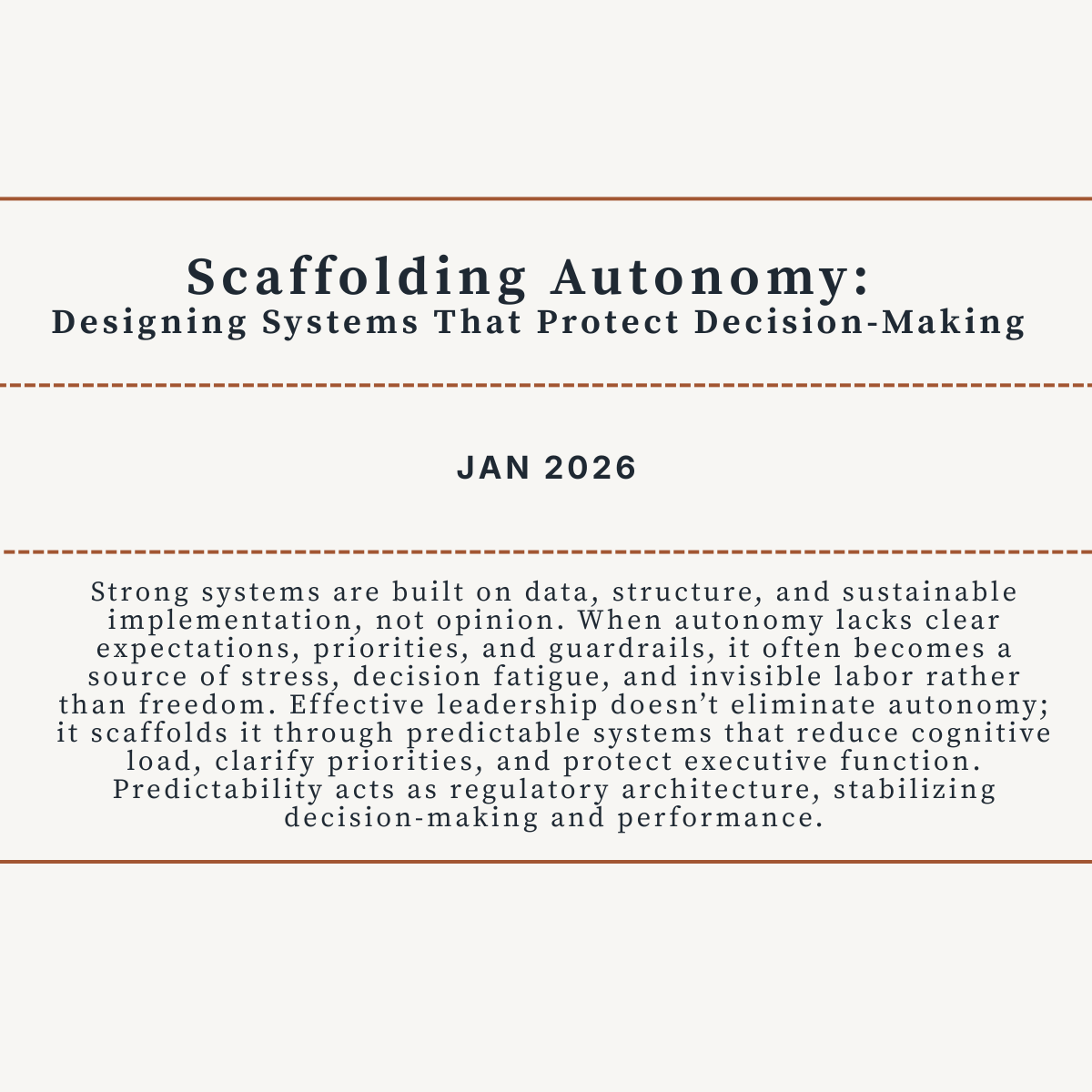
Cover page of a report titled 'Scaffolding Autonomy: Designing Systems That Protect Decision-Making,' published in January 2026, with a description of the importance of system design in autonomous systems.

Recent Publications

Cover page of a handbook titled "Why Do Reforms Fail? Strategy that Works in the Real World." from Edgewood University, Massachusetts, USA, December 2025. It includes a description of the handbook's focus on system effectiveness, organizational change, policy development, training, leadership, and evaluation with insights from neuroscience and real-world practice.